

AI-Powered Telecom for Leading Strategic Growth and Innovation
The telecommunications industry is at a critical juncture, with telcos uniquely positioned to drive digital transformation and economic growth. By building robust AI infrastructures, telcos can offer advanced AI services to various sectors, from healthcare to finance, creating new revenue streams and fostering cross-industry partnerships.
Supermicro, in collaboration with NVIDIA, delivers AI-powered infrastructure tailored for telcos, enhancing operational efficiency, network management, and customer experiences. Our solutions enable telcos to leverage AI for strategic growth, positioning them as leaders in the evolving digital economy.

“The global AI in telecommunication market is expected to grow at a 41.4% CAGR from 2024 to 2033, with applications across network security, optimization, customer analytics, virtual assistance and self-diagnostics”
“90% of telco executives report that their organizations are currently engaged with AI from the experimentation stage to full-scale deployment”
AI Factories for Sovereign AI Infrastructure
Elevating the Telecom Network with Cutting-Edge AI Services
- Unlock new telco revenue streams
- Sovereign, secure AI platforms for critical applications
- Distributed, low-latency AI inferencing
- End-to-end infrastructure solutions
AI factories enable telcos to enhance their networks with specialized AI infrastructure, supporting national AI initiatives and providing secure, high-performance solutions to business users.
“‘Cooperation with global leading companies in the AI data center sector will be the cornerstone for SK Telecom to emerge as a global AI company,’ SK Telecom CEO Ryu Young-sang said. ‘Through cooperation with Supermicro and Lambda, SK Telecom’s AI data center business is expected to achieve meaningful results within this year.’”
“‘I am a firm believer that every country ought to have some sovereign capability on artificial intelligence, including large language models for AI,’ said IBM chairman and CEO Arvind Krishna. ‘The government needs to support setting up national AI computing centers and common data sets for specific use cases5.’”
5G Monetization with Edge AI and 6G Research
Maximizing 5G Potential and Driving 6G Innovation
- 5G Edge Monetization
- AI RAN
- AI-Driven 6G R&D
- Edge Computing
Telcos can capitalize on 5G monetization and accelerate 6G innovation by integrating AI, creating new revenue streams and enhancing connectivity with advanced edge computing and immersive experiences.
“According to GSMA, the network accounts for 90% of energy use for an operator on average and the RAN represents more than 80% of this. 97% of executives in the survey believe that embracing higher levels of autonomous networks will optimize energy usage, concurrently reducing carbon emissions within their organizations”
“‘When we are designing the 6G network, we’re going to use AI technology in designing the air interface and also in managing the 6G network,’ says Qin. ‘The 6G network will self-train, self-learn, and it will actually grow to become more and more powerful6.’”
Reimagining Contact Centers
Enhancing Customer Experiences with AI
- Automated Inquiry Handling
- Enhanced Representative Support
- Seamless Omnichannel Experience
- B2B Service Expansion
AI-powered contact centers transform customer interactions, streamline operations, and offer advanced support, making them a valuable asset for both internal use and B2B offerings.
“Communication Service Providers are placing strong emphasis on using generative AI to enhance customer-centricity with chatbots the most widely adopted use case, with 63% of respondents who selected this use case indicating it was already in production”
62% of customers would rather use a customer service chatbot than wait for a human representative1.
Streamlined Network Operations
Optimizing Efficiency with AI-Driven Automation
- Automated Maintenance
- Self-Optimizing Networks
- 5G Enhancement
- Predictive Analytics
AI-driven solutions streamline network operations, enhance efficiency, and improve service quality by automating maintenance and optimizing resource management.
“Improving efficiency and productivity by using generative AI is by far the highest value driver. 41% of Communication Service Providers see generative AI as assisting employees in producing quicker and higher quality output”
In 2023, 37% of respondents were investing in network predictive maintenance and 34% were investing in network planning and operations (including RAN)2.
By 2028, 61% of telco aspire to at least achieve a conditional autonomous network that can sense real-time environmental changes and, in certain network domains, optimize and adjust its operation to the external environment to enable intent-based closed-loop management3.
Predictive Analytics for Business Insights
Transforming Business Intelligence through AI
- Advanced Customer Insights
- Operational Efficiency
- B2B Services Expansion
- Customized Solutions
AI-powered predictive analytics enable telcos to gain deeper customer insights, enhance operational efficiency, and extend valuable services to B2B clients, driving business success and innovation.
“42% of telcos respondents are piloting or have a partial/full scale implementation of an autonomous network to understand subscriber churn/behavior and take corrective action to retain customers”
“I have seen how AI can help increase productivity in customer care operations and create new services such as personalized customer experiences, targeted marketing campaigns and automated customer service chatbots4.”
Sovereign AI on Telecom Infrastructure
As AI reshapes digital economies, telecom operators have a strategic opportunity to unlock new revenue streams by evolving into enablers of sovereign AI infrastructure. With global AI infrastructure spending projected to surge, enterprises and governments urgently need secure, compliant, low-latency platforms to operationalize AI at scale.
Telcos are uniquely positioned to meet this demand by leveraging their infrastructure, data stewardship, and edge capabilities. By enabling regional AI factories and distributed inferencing, operators can deliver high-performance, sovereign AI services—positioning themselves at the core of the emerging AI-driven digital economy.
Download the paper about Sovereign AI for Telecom to learn more:

![YouTube: [Supermicro] Sovereign AI Factories: The Challenges and Opportunities for Telcos](https://img.youtube.com/vi/yfb00IHYgII/maxresdefault.jpg)
Telecom AI Factory Solutions
Supermicro’s AI Factory solutions, in partnership with NVIDIA, provide telecom operators with a complete, turnkey platform to build their sovereign AI infrastructure. Featuring full-stack, NVIDIA-Certified systems, AI Factories integrate high-performance GPUs, Spectrum-X networking, storage, and AI software for rapid deployment in edge and regional data centers.
Supermicro AI Factories are used by leading operators to deliver secure, low-latency GPU-as-a-Service and sovereign AI capabilities to enterprises, governments, and national initiatives—ensuring full data control and compliance.

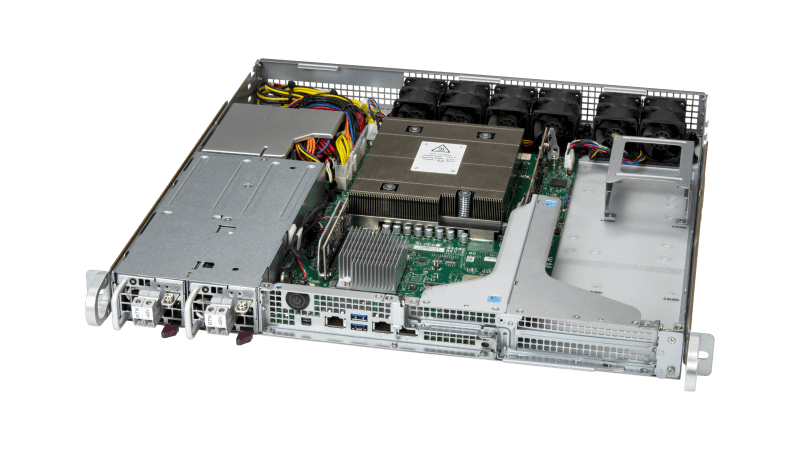
SYS-E403-13E-FRN2T
| Dimensions (mm) H × W × D | 117.3 × 266.7 × 406.4 |
|---|---|
| Cooling | Air |
| Key Features | 5885 (Llama v2 7B) ɸdLLM Throughput(Tokens/sec per GPU) |
Use Cases:
| |
| GPU Support |
|
SYS-111E-F(D)WTR
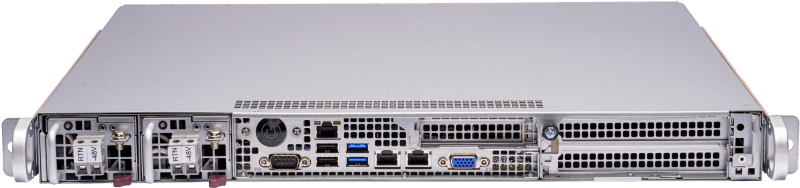
| Dimensions (mm) H × W × D | 43 × 437 × 429 |
|---|---|
| Cooling | Air |
| Key Features | 5885 (Llama v2 7B) ɸeLLM Throughput(Tokens/sec per GPU) |
Use Cases:
| |
| GPU Support |
|

SYS-221HE-FTNR(D)
| Dimensions (mm) H × W × D | 89 × 437 × 574 |
|---|---|
| Cooling | Air |
| Key Features | 2335 (Llama v2 70B) *cLLM Throughput(Tokens/sec per GPU) |
Use Cases:
| |
| GPU Support |
|
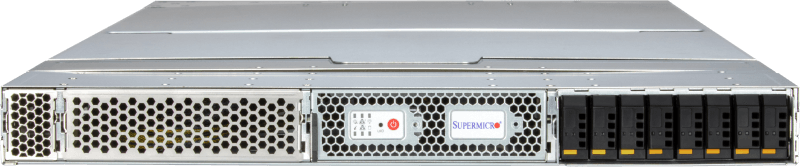
ARS-111GL-NHR
| Dimensions (mm) H × W × D | 44 × 440 × 940 |
|---|---|
| Cooling | Air |
| Key Features | 3401 (Llama v2 70B) ɸaLLM Throughput(Tokens/sec per GPU) |
Use Cases:
| |
| GPU Support |
|
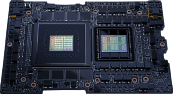
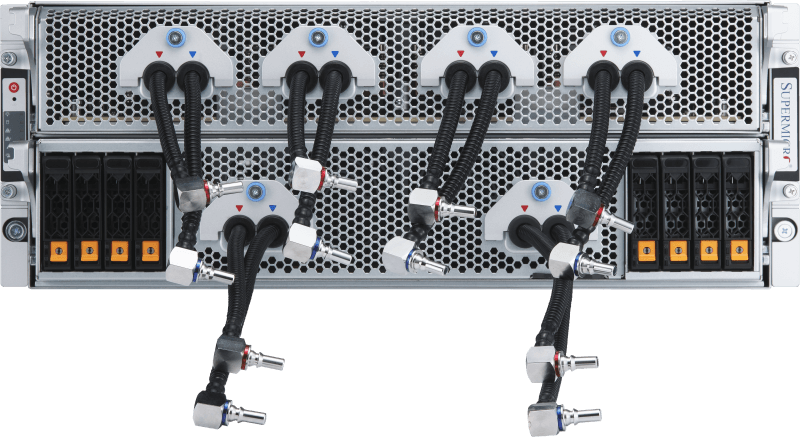
SYS-421GE-TNHR2-LCC
| Dimensions (mm) H × W × D | 174 × 449 × 842 |
|---|---|
| Cooling | Liquid |
| Key Features | 3269 (Llama v2 70B) ɸbLLM Throughput(Tokens/sec per GPU) Data Center Cluster:
|
Use Cases:
| |
| GPU Support |
|
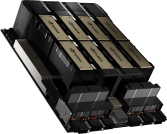
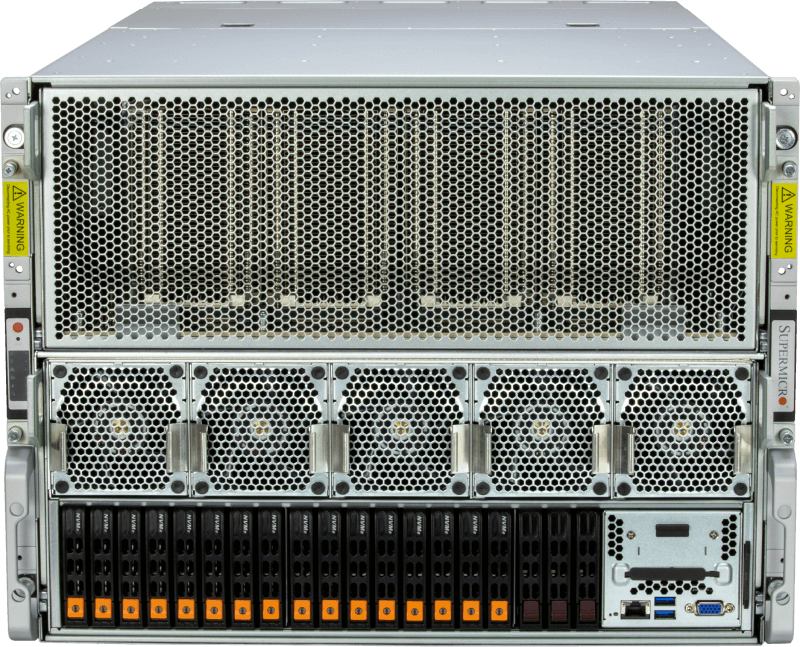
SYS-821GE-TNHR
| Dimensions (mm) H × W × D | 356 × 437 × 843 |
|---|---|
| Cooling | Air |
| Key Features | 3269 (Llama v2 70B) ɸbLLM Throughput(Tokens/sec per GPU) Data Center Cluster:
|
Use Cases:
| |
| GPU Support |
|
- Input Length = 128, Output Length = 128, Batch Size = 256
- Input Length = 128, Output Length = 128, Batch Size = max
- TP = 1, with 1x GH100
- TP = 2, with 2x H100
- TP = 1, with 1x H100 NVL
- TP = 1, with 1x L40S
- TP = 1, with 1x L40