

What Is Edge-to-Cloud?


Edge-to-cloud is an IT architecture model that seamlessly connects edge computing environments with centralized cloud infrastructure to enable unified data processing , management, and orchestration across distributed systems. It allows data to be processed closer to where it is generated, at the network edge, while integrating with cloud computing platforms for large-scale analytics, long-term storage, artificial intelligence (AI), and enterprise applications .
In an edge-to-cloud architecture, compute, storage, and networking resources are deployed across multiple locations, ranging from remote edge sites and branch offices to regional data centers and public or private cloud environments, including sites that may require ruggedized or environmentally resilient systems. This distributed framework ensures that latency-sensitive workloads are handled locally at the edge, while only relevant or aggregated data is transmitted to centralized cloud infrastructure for large-scale processing and analytics.
This approach is particularly valuable in industries that generate large volumes of real-time data, such as manufacturing, telecommunications, healthcare, retail, transportation , and smart cities. By bridging the edge and the cloud, organizations can improve operational efficiency, enhance application performance, and gain actionable insights from data regardless of where it is created.
How Edge-to-Cloud Architecture Works
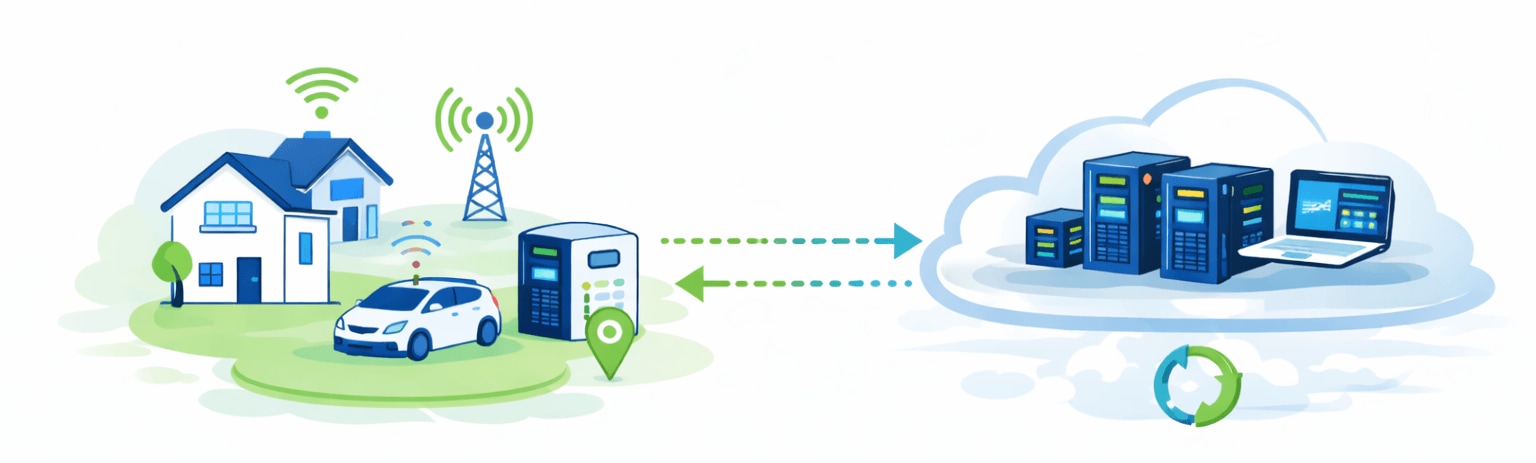
Edge-to-cloud architecture operates as a unified compute continuum that extends from data-generating endpoints to centralized cloud environments. Rather than treating edge and cloud as separate infrastructures, this model integrates them into a coordinated ecosystem where workloads, data, and applications can move dynamically based on performance, latency, cost, and compliance requirements.
At the edge, data is generated by devices, sensors, systems, and users. Localized edge servers process latency-sensitive workloads in near real time, minimizing backhaul traffic and enabling immediate operational responses. This is critical for applications requiring deterministic performance, including industrial control systems, AI inference at the edge , video analytics, and 5G network functions.
Between the edge and centralized cloud environments, regional or core data centers often serve as aggregation and orchestration hubs. These environments consolidate data from distributed edge sites, enforce security policies, manage infrastructure, and support hybrid deployment models. They provide a control plane for monitoring, automation, and workload lifecycle management across the distributed estate.
The cloud layer delivers elastic scalability for compute-intensive workloads, advanced analytics, AI training, long-term data retention, and enterprise applications. By integrating public, private, and hybrid cloud platforms, organizations can maintain consistent governance and operational visibility across all locations.
A defining characteristic of edge-to-cloud architecture is intelligent workload placement. Applications and data are processed where it makes the most operational and economic sense, whether at the edge for real-time responsiveness or in the cloud for large-scale analytics and centralized management. This flexible deployment model enables organizations to accelerate digital transformation while maintaining performance, security, and efficiency across distributed environments.
Core Components of an Edge-to-Cloud Environment
An edge-to-cloud environment is built on a distributed yet unified infrastructure stack that enables data processing, storage, networking, and orchestration across multiple locations. Each layer of the architecture plays a distinct role in ensuring performance, scalability, and operational consistency from edge endpoints to centralized cloud platforms. The effectiveness of an edge-to-cloud strategy depends on how well these core components integrate to support diverse workloads and dynamic deployment requirements.
Edge Compute Infrastructure
Edge compute infrastructure consists of compact, high-performance servers deployed close to data sources. These systems are designed to operate in space-constrained or environmentally challenging locations such as factory floors, retail branches, cell towers, and remote facilities. Edge servers process latency-sensitive workloads locally, enabling real-time analytics, AI inference , and operational control without relying on constant cloud connectivity.
Modern edge systems often incorporate GPU acceleration, AI accelerators , and high-speed networking to support data-intensive applications. Reliability, power efficiency, and remote manageability are critical design considerations for edge deployments.
Networking and Connectivity
Reliable connectivity is essential for integrating distributed edge sites with regional data centers and cloud platforms. Edge-to-cloud architectures typically rely on high-speed Ethernet, fiber, 5G, SD-WAN, and secure VPN connections to ensure efficient data transmission.
Networking infrastructure must support low-latency communication for real-time applications while also enabling secure data transport for aggregated workloads. Intelligent traffic routing and bandwidth optimization help balance performance requirements with operational costs.
Storage Architecture
Storage systems in an edge-to-cloud environment must accommodate both local and centralized data needs. At the edge, high-performance storage enables rapid data ingestion and short-term processing. In centralized data centers or cloud environments, scalable storage solutions support long-term retention, backup, compliance, and large-scale analytics.
Data synchronization mechanisms ensure consistency across distributed locations, while tiered storage strategies optimize performance and cost efficiency. The ability to move data seamlessly between edge and cloud environments is a foundational capability of this architecture.
Centralized Management and Orchestration
Unified management platforms provide visibility and control across the entire edge-to-cloud continuum. These systems enable administrators to deploy workloads, monitor infrastructure health, enforce security policies, and automate lifecycle management from a centralized control plane.
Orchestration tools support containerized and virtualized environments, allowing applications to run consistently across edge servers, on-premises data centers , and public or private cloud platforms. Centralized management reduces operational complexity and ensures governance across geographically distributed deployments.
Security Framework
Security in an edge-to-cloud environment must extend across all layers of the infrastructure. Hardware-based security features, secure boot mechanisms, encryption, and zero-trust principles protect data and workloads from endpoint to cloud.
Because edge sites often operate outside traditional data center perimeters, robust authentication, device integrity validation, and continuous monitoring are essential. A comprehensive security framework ensures that distributed computing environments remain resilient against evolving threats.
Why Edge-to-Cloud Matters for Modern Enterprises
Today, many enterprises generate large volumes of data from distributed sources, including connected devices, operational systems, and digital applications. Relying solely on centralized cloud infrastructure can introduce latency, bandwidth constraints, and increased costs, while edge-only deployments may limit scalability and advanced analytics capabilities. Edge-to-cloud architecture balances these models by combining localized processing with centralized intelligence.
Real-time decision-making is a primary driver of adoption. Industries such as manufacturing, healthcare, retail, energy, and telecommunications require immediate insights to maintain operational performance. Processing latency-sensitive workloads at the edge reduces delays and improves reliability, while cloud platforms support deeper analytics and long-term optimization.
Edge-to-cloud environments also improve bandwidth efficiency by filtering and analyzing data locally before transmitting relevant information to centralized systems. This reduces network congestion and optimizes cloud resource utilization.
Security and compliance requirements further support this approach. Organizations can process sensitive data locally to meet regulatory obligations while maintaining secure integration with centralized infrastructure.
As AI initiatives expand, models can be trained in the cloud and deployed to edge systems for real-time inference. This unified framework enables enterprises to scale efficiently, maintain governance, and accelerate innovation across distributed environments.
Edge-to-Cloud vs. Cloud-Only and Edge-Only Models
Understanding edge-to-cloud architecture requires comparing it to cloud-only and edge-only deployment models. While each approach serves specific use cases, edge-to-cloud integrates the strengths of both to deliver greater flexibility, performance, and scalability.
Cloud-Only Model
In a cloud-only model, data generated at endpoints is transmitted directly to centralized cloud platforms for processing, storage, and analysis. This approach offers elastic cloud scalability , centralized management, and access to advanced analytics and AI services.
However, cloud-only architectures can introduce latency when processing time-sensitive workloads. They also depend heavily on reliable, high-bandwidth connectivity. For environments that generate large volumes of data or require immediate operational responses, continuously transmitting data to the cloud may increase bandwidth costs and reduce performance efficiency.
Edge-Only Model
An edge-only model processes and stores data entirely at or near the source. This approach minimizes latency and reduces dependence on external connectivity, making it well suited for real-time control systems and remote locations with limited network access.
While edge-only deployments provide responsiveness and localized resilience, they can lack the scalability and advanced analytics capabilities delivered by high-performance data center hardware in centralized cloud environments. Managing numerous isolated edge sites may also increase operational complexity without a unified orchestration framework.
The Edge-to-Cloud Advantage
Edge-to-cloud architecture combines localized processing with centralized scalability. Latency-sensitive workloads run at the edge, while aggregated data, large-scale analytics, and long-term storage are handled in regional data centers or cloud platforms.
This integrated approach enables intelligent workload placement, allowing organizations to process data where it delivers the greatest operational and economic value. By unifying edge and cloud environments under a consistent management and security framework, edge-to-cloud architecture reduces complexity while maximizing performance, efficiency, and visibility across distributed systems.
Edge-to-Cloud Deployment Considerations
Successful edge-to-cloud deployments require careful planning across infrastructure, networking, security, and operations. Organizations must design standardized architectures that can scale across distributed locations while maintaining consistent performance and workload portability. Network capacity, latency requirements, and redundancy planning are critical to ensure reliable connectivity between edge sites and centralized cloud environments.
Security and governance must extend across the entire continuum, including identity and access management, data encryption, secure device onboarding, and compliance with data sovereignty regulations. Consistent policy enforcement and centralized visibility are critical to maintaining operational control across distributed infrastructure and modernized data centers .
Operational management is equally important. Enterprises need unified orchestration, remote lifecycle management, and visibility into system health across all locations. Power efficiency, environmental resilience, and total cost of ownership should also be evaluated to ensure long-term sustainability and operational efficiency in distributed deployments.
Common Edge-to-Cloud Use Cases
Edge-to-cloud architecture supports a wide range of distributed, data-intensive workloads that require both real-time responsiveness and centralized scalability. By combining localized processing with cloud-based analytics and management, organizations can optimize performance, cost, and operational efficiency across industries.
Smart Manufacturing
Manufacturers use edge-to-cloud infrastructure to monitor equipment, automate production lines, and enable predictive maintenance. Edge systems process sensor data in real time to prevent downtime, while cloud platforms aggregate operational data for long-term analytics, optimization, and AI model training.
Retail Analytics
Retail environments deploy edge systems to analyze in-store traffic, manage inventory, and personalize customer experiences. Real-time insights are generated locally, while centralized cloud systems consolidate data across locations to support forecasting, supply chain coordination, and business intelligence.
Healthcare and Medical Imaging
Healthcare providers process medical imaging and patient data at the edge to support time-sensitive diagnostics. Cloud environments enable secure data storage, large-scale analytics, and AI-assisted analysis while maintaining compliance with regulatory requirements.
Telecommunications and 5G Networks
Telecommunications providers deploy edge infrastructure to support low-latency applications, virtualized network functions, and 5G services. Centralized cloud platforms manage orchestration, analytics, and network optimization across distributed sites.
AI Inference at the Edge
Organizations deploy trained AI models from the cloud to edge systems for real-time inference in applications such as video analytics, autonomous systems, and industrial automation. This approach enables immediate decision-making while maintaining centralized model management and updates.
Edge-to-Cloud and Artificial Intelligence
AI is a primary driver of edge-to-cloud adoption. AI workloads often require a distributed architecture in which model training, inference, and data management occur across multiple environments. Edge-to-cloud infrastructure enables organizations to train AI models in centralized cloud or core data center environments using large aggregated datasets, then deploy optimized models to edge systems for real-time inference.
This approach reduces latency and bandwidth consumption while ensuring consistent model governance and lifecycle management. Edge systems equipped with GPUs or specialized accelerators can process video streams, sensor data, and operational inputs locally, enabling immediate decision-making in applications such as industrial automation, intelligent retail, healthcare diagnostics, and telecommunications.
At the same time, centralized cloud platforms provide scalable resources for model retraining, performance monitoring, and continuous improvement. By integrating AI workflows across distributed infrastructure, edge-to-cloud architecture supports hybrid and multi-cloud strategies while maintaining visibility, security, and operational control. This coordinated framework allows enterprises to operationalize AI efficiently across geographically distributed environments.
FAQs
- What’s an example of edge-to-cloud?
A smart manufacturing facility is a common example. Sensors and machines process operational data locally for real-time control, while aggregated data is transmitted to centralized cloud platforms for analytics, predictive maintenance modeling, and long-term performance optimization. - Is edge-to-cloud the same as distributed computing?
Edge-to-cloud is a form of distributed computing, but it specifically integrates edge infrastructure with centralized cloud platforms. It emphasizes coordinated workload placement, unified management, and seamless data movement across the computing continuum. - Why is edge-to-cloud important for digital transformation?
Edge-to-cloud enables organizations to modernize infrastructure by supporting real-time processing, scalable analytics, and AI deployment across distributed environments. This unified architecture accelerates innovation, improves operational visibility, and supports data-driven decision-making at enterprise scale. - How does edge-to-cloud improve data gravity and bandwidth efficiency?
Edge-to-cloud architectures process and filter data locally before transmitting relevant or aggregated information to centralized environments. This reduces unnecessary data transfer, lowers bandwidth costs, and ensures that large datasets remain close to where they deliver the most value. - What security challenges exist in edge-to-cloud environments?
Edge-to-cloud environments expand the attack surface due to distributed locations and connected devices. Organizations must implement strong identity management, encryption, secure device onboarding, and continuous monitoring to protect data and maintain consistent security policies across environments. - How does edge-to-cloud reduce latency?
Edge-to-cloud reduces latency by processing time-sensitive workloads near the data source rather than transmitting all data to centralized cloud platforms. Localized processing enables faster response times for applications requiring real-time analytics or operational control.